
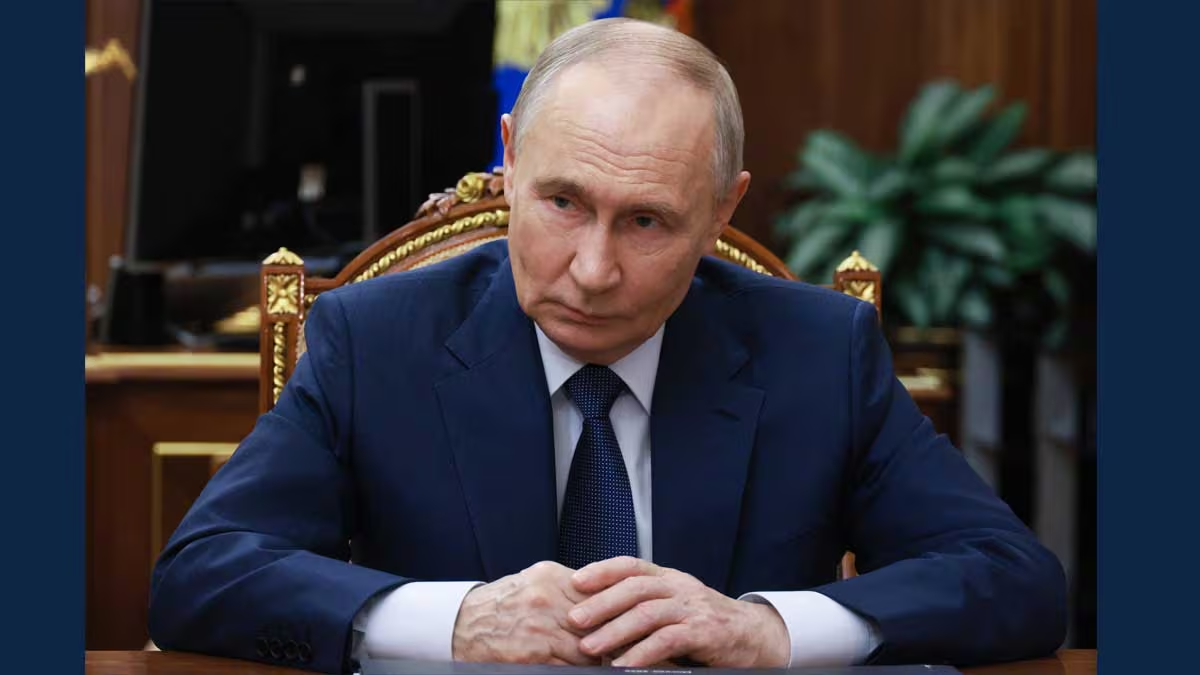
In a powerful declaration of enduring bilateral synergy, Russian President Vladimir Putin has strongly reaffirmed the strategic partnership between Moscow and New Delhi, describing India-Russia ties as deeply “brotherly” and firmly “trust-based.” Speaking at the prestigious St. Petersburg International Economic Forum (SPIEF) on Friday, Putin delivered a pointed message directed at Washington and its Western allies amid looming threats of secondary sanctions over India’s continued procurement of Russian oil.
Assuring the world that the deep-rooted relationship between the two nations transcends volatile political environments, Putin’s remarks underscore a shifting geopolitical landscape where traditional alliances hold their ground against unilateral pressures. “Nobody can dictate terms to us, and nobody would even try to do so,” the Russian President stated emphatically, cementing Russia’s commitment to its sovereign partnerships.
The Resiliency of a “Brotherly” Partnership
At the core of President Putin’s address was the characterization of the India-Russia alliance as an unbreakable bond built on decades of mutual respect. As Western nations continue to isolate Russia economically and diplomatically following the war in Ukraine, Moscow has increasingly pivoted toward Asia, with India emerging as one of its most critical economic and strategic lifelines. Putin emphasized that this relationship is not a temporary marriage of convenience dictated by the current political climate, but rather a time-tested friendship.
By utilizing the term “brotherly,” Putin invoked the historical warmth that has characterized New Delhi and Moscow’s interactions since the Cold War era. This trust-based dynamic, he argued, allows both nations to pursue their respective national interests without the fear of conditional diplomacy. In an era where international relations are heavily transactional, Putin positioned the Russia-India framework as a gold standard of collaborative diplomacy that honors commitments regardless of external geopolitical headwinds.
High Praise for India’s Tech Talent and Economic Growth
Beyond global politics and defense, Putin dedicated a significant portion of his time at the SPIEF to laud India’s domestic capabilities, particularly its human capital. Acknowledging India’s rapid ascent as a global technology hub, the Russian leader praised the nation’s immense and highly skilled talent pool.
“We know how talented the Indian people are and how well educated they are,” Putin remarked, highlighting that Indians possess outstanding competencies that have rightfully earned global recognition. He specifically pointed out India’s dominance in coding, software development, and several other advanced technological fields.
This acknowledgment is not merely complimentary but points toward Russia’s strategic desire to deepen cooperation in the IT and technology sectors. With Western tech companies having exited the Russian market, Moscow is actively looking toward Indian innovators and IT giants to bridge the technological gap, fostering joint ventures that move beyond traditional commodities and into the realm of the digital economy.
Energy Security Amidst Global Uncertainties
One of the most crucial pillars of modern India-Russia relations is energy cooperation. As global markets face unprecedented uncertainty due to the ongoing West Asia crisis and potential supply chain disruptions in the Strait of Hormuz, Putin highlighted how the partnership has proven mutually beneficial in stabilizing both economies.
Reflecting on the pragmatic leadership of Prime Minister Narendra Modi, Putin noted that when global fuel prices threatened to derail domestic economies, India and Russia made the strategic choice of close cooperation. He recalled moments when the Indian government had to urge citizens to minimize travel due to global oil anxieties. “I believe our companies made the right decision, and so did our Indian counterparts, when they chose the path of close cooperation,” Putin explained.
Today, Russia has dramatically increased its crude oil supplies to the Indian market, fundamentally restructuring global energy flows. By offering oil at discounted rates, Russia has helped India combat inflation and secure its immense energy needs, while India has provided Russia with a crucial, steady revenue stream amidst stringent Western embargoes.
A Legacy of Defense Cooperation and Joint R&D
The bedrock of the India-Russia relationship has historically been defense and military cooperation, an aspect Putin proudly highlighted. Despite India’s recent efforts to diversify its defense portfolio with acquisitions from the United States, France, and Israel, a significant portion of the Indian Armed Forces continues to operate and rely on Russian-made military equipment.
Putin traced this military dependency back to the Soviet era, noting that the relationship is unique because it is fundamentally built on unwavering mutual trust. Crucially, he emphasized that the modern defense partnership is rapidly evolving. “We are focused not merely on trade and commerce, but also on joint research and development,” Putin stated.
He cited the BrahMos supersonic cruise missile—a highly successful joint venture between India and Russia—as a shining example of what the two nations can achieve together. This shift from a traditional ‘buyer-seller’ dynamic to collaborative manufacturing aligns perfectly with Prime Minister Modi’s ‘Make in India’ initiative.
Navigating the US Factor and Sovereign Choices
Perhaps the most globally scrutinized aspect of Putin’s speech was his direct commentary on the United States and the looming threat of sanctions. Washington has repeatedly expressed unease over New Delhi’s booming trade with Moscow, subtly warning of potential consequences. Putin dismissed these pressure tactics, asserting that sanctions imposed on a rapidly growing economic powerhouse like India would ultimately prove counterproductive and economically damaging for the nations trying to enforce them.
Demonstrating a nuanced understanding of India’s multi-aligned foreign policy, Putin openly acknowledged the growing strength of India-US relations. He displayed no outward anxiety over New Delhi’s partnerships with Western powers. Instead, he stressed that India is a sovereign power completely free to make independent decisions based solely on its national interests. “India is free to choose the products it considers most advanced, most suitable for its needs, and those that offer the best value in terms of price and quality,” he affirmed.
Conclusion: A Defining Axis of the 21st Century
Vladimir Putin’s extensive remarks at the St. Petersburg International Economic Forum serve as a robust testament to the vitality of the India-Russia strategic partnership. By praising Indian talent, highlighting joint defense successes, and reinforcing energy ties, Moscow is signaling its long-term commitment to New Delhi. More importantly, by publicly supporting India’s right to strategic autonomy, Putin has cleverly contrasted Russia’s “trust-based” approach with the “dictated terms” often associated with Western diplomacy. As global geopolitical fault lines continue to shift, the “brotherly” bond between Russia and India remains a defining axis of the modern world order.




Leave a Reply