
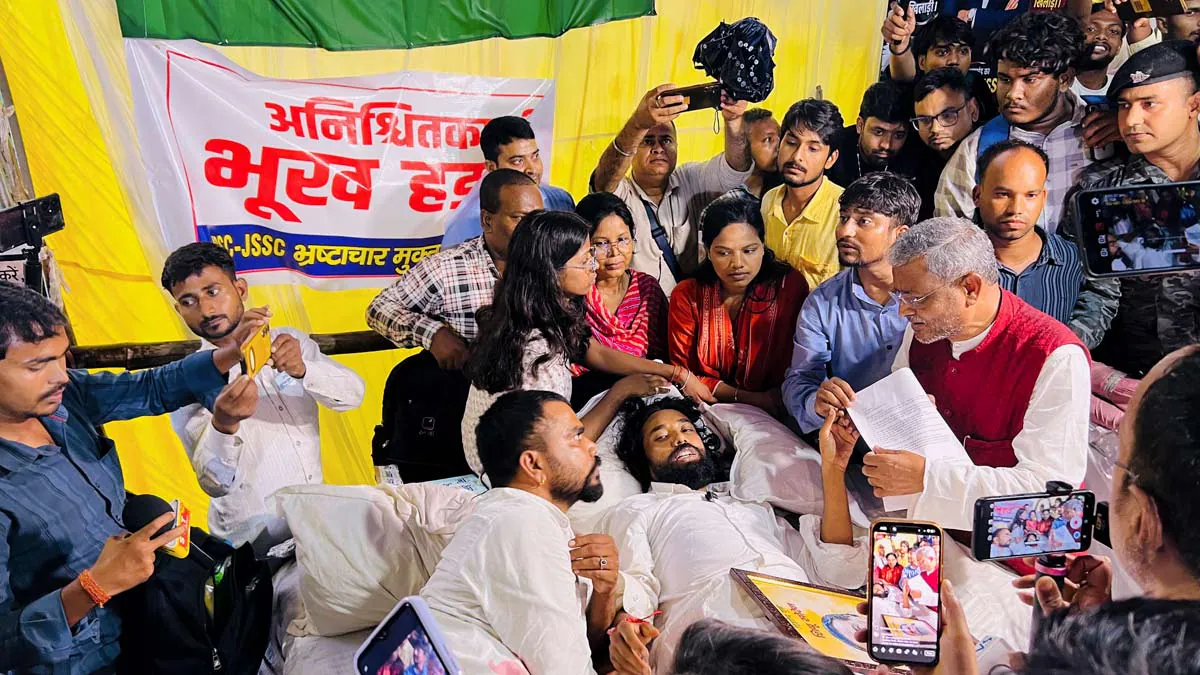
RANCHI — For nearly a week, the grounds of the Jaipal Singh Munda Stadium in Ranchi have transformed into a ground zero of youthful desperation and unwavering defiance. Thousands of Gen Z job aspirants and students from across Jharkhand have been staging a massive, indefinite protest, demanding accountability for a recruitment system they say is deeply broken. Now, in a significant development, the state government has extended an olive branch, expressing readiness to hold talks with the agitating students. However, the protesters, scarred by years of unfulfilled promises, have set two firm and non-negotiable conditions for any negotiation: the dialogue must take place directly with Chief Minister Hemant Soren, and it must happen in the open, under the watchful lenses of live media.
The current wave of protests was triggered by widespread allegations of paper leaks and glaring irregularities in the recently conducted 14th Jharkhand Public Service Commission (JPSC) and the Jharkhand Staff Selection Commission (JSSC) CGL examinations. For the thousands of students who have spent years—and their families’ hard-earned savings—preparing for these competitive exams, the allegations of corruption were the final straw. They argue that the controversy is merely the latest chapter in a depressing cycle of delayed notifications, leaked question papers, cancelled exams, and stalled results that has plagued the state since its formation in 2000.
Sensing the growing political and social fallout ahead of the upcoming Monsoon Session of the State Assembly, the Jharkhand government has signaled its willingness to step in. State Minister Irfan Ansari recently addressed the media, confirming that the government is opening its doors for dialogue. “The Chief Minister has constituted a committee… We have opened the door for dialogue,” Ansari stated. “Talks will take place, we will listen to your demands, and if they are reasonable, we will certainly accept them. They are our students, our children.” Furthermore, Jharkhand Rural Development Minister Deepika Pandey Singh affirmed that the Chief Minister has taken a positive approach to resolving the crisis, urging the students to name their delegation for formal engagement.
Yet, the students remain highly skeptical of bureaucratic maneuvers. While they welcomed the message relayed through the Sub-Divisional Officer (SDO) regarding the government’s readiness to negotiate, they have fundamentally rejected the state’s traditional playbook of holding discussions in secluded chambers. Student leader Ravindra Paswan articulated the collective consensus of the protesters: any meeting with the government will not happen behind closed doors.
“Our primary condition is that the dialogue should take place directly with the Chief Minister, and we have been assured that the Chief Minister will be present,” Paswan noted. “Secondly, we want at least two media representatives to be present during the discussions.”
Another protester elaborated on the rationale behind these conditions, pointing out that historical precedents in Jharkhand have left them deeply distrustful of private negotiations. “If the Chief Minister comes out to speak with us publicly in front of live media on an open platform, a proper resolution could be reached,” the student said. “In our previous protest, our representatives were taken into a closed room, and nothing came out of it. For the last 26 years in Jharkhand, students’ issues have been heard in closed rooms, and the files have remained closed forever.” The students fear that calling a small, five-member delegation into a private office is merely a stalling tactic designed to fragment and suppress their movement.
The urgency of the situation is escalating by the hour, fueled by the physical toll the protests are taking on the youth. The agitation has witnessed high-profile hunger strikes that have drawn national attention. Devendra Nath Mahto, a prominent face of the protests, undertook a grueling fast that only ended on its fourth day after renowned climate activist and education reformer Sonam Wangchuk personally intervened, urging Mahto to at least consume water to sustain his fight. But the baton of the hunger strike has already been passed on. Just days ago, five more individuals—including two women—under the banner of the JPSC, JSSC Reforms Manch began an indefinite hunger strike, raising the total number of fasting protesters to six. They have vowed not to eat until their demands are met.
The political ramifications of the youth uprising are also widening. Dumri MLA Jairam Mahto, leader of the Jharkhand Loktantrik Krantikari Morcha (JLKM), has thrown his full weight behind the students. Mahto recently led a sit-in protest at Memco More in Dhanbad, demanding strict action against the masterminds of the alleged leaks. He issued a stern warning to the state government, stating that if the students’ demands are not addressed promptly, his party will intensify the agitation and march to the state Assembly.
At the heart of the standoff is a fundamental lack of trust in the state’s investigative machinery. While the Jharkhand Police’s Criminal Investigation Department (CID) has swung into action—arresting 14 individuals, conducting raids across multiple districts, and interrogating former JPSC chairman L. Khiangte—the protesters are entirely unimpressed. They allege that the CID is being used to cover up the involvement of high-ranking officials and political elites. Consequently, their primary demands remain the immediate cancellation of the 14th JPSC examination and the transfer of the investigation to the Central Bureau of Investigation (CBI), or alternatively, an independent probe monitored by retired high court judges from outside the state.
The students are also demanding systemic, long-term reforms to safeguard their futures. Among their structural demands is a policy to award the contracts for different stages of examination processes to separate, independent firms to prevent monopolies and reduce the risk of coordinated leaks.
As the standoff continues, the ball is squarely in the court of Chief Minister Hemant Soren. While Finance Minister Radhakrishna Kishore clarified that the newly formed ministerial committee is currently tasked only with monitoring the agitation rather than finalizing negotiations, the pressure for the Chief Minister to personally step into the light is mounting. The youth of Jharkhand are no longer willing to accept whispered assurances in closed rooms. They want transparency, they want accountability, and they want it broadcast for the entire state to see. Whether the government will agree to this unprecedented open dialogue remains to be seen, but one thing is certain: Jharkhand’s Gen Z has permanently rewritten the rules of civic engagement in the state.



Leave a Reply