
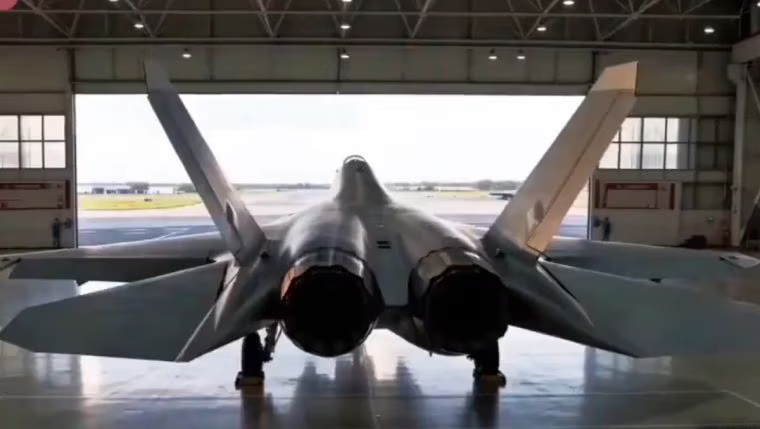
The J-35 Revelation: A New Challenge on the Horizon
On May 6, 2026, fresh reports emerged from Beijing showcasing the advanced operational readiness of the Shenyang J-35, China’s premier fifth-generation carrier-based and land-based stealth fighter. Designed as a direct competitor to the American F-35, the J-35 represents the pinnacle of Chinese aerospace engineering. However, for New Delhi, the real concern is not just the aircraft’s existence, but the growing likelihood of its export to the Pakistan Air Force (PAF).
Speculation has reached a fever pitch following hints from the PAF leadership regarding their interest in the J-35. If Pakistan succeeds in inducting these jets in the near future, it could potentially fly a fifth-generation stealth fighter before India, marking a significant psychological and tactical milestone in their long-standing rivalry.
The “Stealth Gap”: Analyzing the 5th Gen Landscape
In modern aerial warfare, “stealth” or Low Observability (LO) is a game-changer. It allows aircraft to penetrate sophisticated Integrated Air Defense Systems (IADS) without being detected by conventional radar.
Currently, the Indian Air Force (IAF) holds a qualitative edge with its fleet of Dassault Rafales, which are 4.5-generation fighters equipped with advanced AESA radars and Meteor beyond-visual-range missiles. However, the Rafale is not a stealth aircraft. Pakistan, by contrast, has been operating the JF-17 Block III and J-10C, both of which are modern but similarly lack true fifth-generation stealth characteristics.
The induction of the J-35 would provide Pakistan with:
- Radar Invisibility: The ability to strike deep within Indian territory while staying below the radar horizon of current Indian sensors.
- Advanced Sensor Fusion: Real-time data sharing between platforms, giving pilots a god-like view of the battlefield.
- Supercruise Capability: The ability to maintain supersonic speeds without using afterburners, increasing range and decreasing the window of engagement for enemy defenses.
India’s Response: The AMCA Roadmap and Its Hurdles
India is not standing still, but its path is significantly different. The IAF is betting on the AMCA (Advanced Medium Combat Aircraft)—a homegrown fifth-generation fighter.
While the Cabinet Committee on Security (CCS) has cleared the funds and the design phase is largely complete, the AMCA is a complex endeavor.
- Development Timeline: The first prototype of the AMCA is expected to roll out in the coming years, with full-scale production likely slated for the early 2030s.
- Engine Challenges: Developing a high-thrust engine that provides stealth and supercruise remains a hurdle, leading to discussions with international partners like Safran (France) or GE (USA).
The dilemma for India is the “Stealth Interregnum”—the period between Pakistan potentially acquiring Chinese stealth tech and India’s AMCA becoming operational.
Counter-Stealth Strategies: S-400 and Beyond
New Delhi is well aware of the threat. To counter the potential arrival of stealth jets in the neighborhood, India has deployed the S-400 Triumf missile defense system. The S-400 is designed to track and engage stealth targets at long ranges. Furthermore, the IAF is focusing on “passive” detection systems and infrared search and track (IRST) sensors that can “see” the heat signature of a stealth jet even if it is invisible to radar.
The Geopolitical Dimension: The China-Pakistan Nexus
The potential transfer of the J-35 is a testament to the “All-Weather Friendship” between Beijing and Islamabad. For China, arming Pakistan with stealth technology serves two purposes: it creates a potent counterweight to India’s growing military might and provides a real-world testing ground for Chinese hardware against Western-origin systems (like India’s Rafales and Mirages).
Conclusion: A Decade of High-Stakes Modernization
The next few years will be critical. If Pakistan manages to secure a squadron of J-35s by 2027-2028, the IAF will face a period of high pressure. India may have to reconsider its procurement strategy, perhaps looking at an “interim” purchase of a foreign fifth-generation platform or accelerating the MRFA (Multi-Role Fighter Aircraft) program to include 5th Gen capabilities.
Ultimately, the race is not just about who flies first, but who can maintain and operate these complex machines effectively in a high-intensity conflict. As the J-35 looms large, the Indian defense establishment must balance the pursuit of “Atmanirbharta” (self-reliance) with the immediate necessity of maintaining regional deterrence.













Leave a Reply