
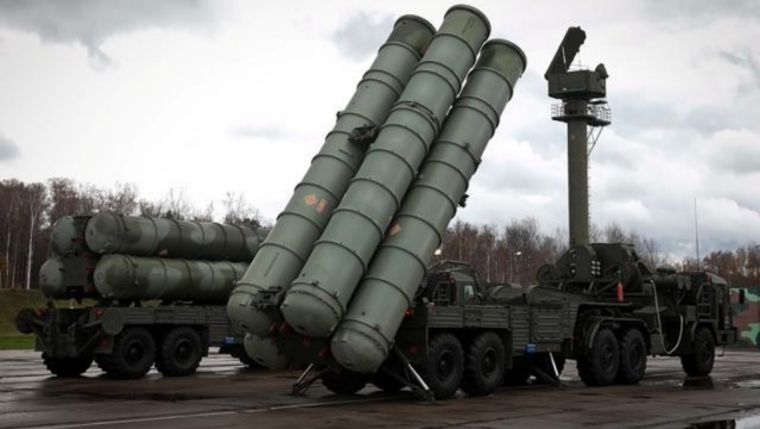
India is set to receive a major boost to its air defence capabilities as the fourth regiment of the advanced Russian S-400 Triumf surface-to-air missile system has been shipped from Russia and is expected to reach Indian shores in mid-May 2026. This delivery comes just days after the first anniversary of Operation Sindoor, the significant 2025 military operation against terrorist infrastructure in Pakistan that highlighted the system’s combat effectiveness.
According to reports, the Indian Air Force (IAF) team completed the pre-dispatch inspection of the system in Russia on April 18, 2026, following which the shipment departed last week. The long-range air defence system is anticipated to arrive at an Indian port in the middle of May, with deployment likely in the Rajasthan sector to strengthen protection along the western border with Pakistan. The fifth and final regiment under the original contract is scheduled for delivery by November 2026.
Background of the Landmark $5.4-5.5 Billion Deal
In October 2018, India signed a landmark agreement worth approximately $5.4–5.5 billion with Russia for five regiments of the S-400 Triumf system. This deal represented one of the largest defence procurements in recent Indian history and underscored the enduring strategic partnership between New Delhi and Moscow.
The S-400, developed by Russia’s Almaz-Antey, is widely regarded as one of the world’s most sophisticated long-range air defence systems. It can simultaneously track and engage multiple aerial threats, including aircraft, drones, cruise missiles, and ballistic missiles, at ranges exceeding 400 km depending on the missile variant. Its ability to deploy different types of missiles makes it highly versatile and effective in creating a robust multi-layered air defence shield.
Deliveries under the contract faced delays primarily due to the Russia-Ukraine conflict, which impacted production and supply chains. The first S-400 regiment reached India in December 2021, the second in 2022, and the third shortly thereafter. The fourth unit’s arrival in mid-2026 marks a key milestone toward completing the original order.
Russian Ambassador to India Denis Alipov reiterated in April 2026 that deliveries of the remaining systems are proceeding as per the mutually agreed timetable and will be completed soon.
Operation Sindoor: Proving Ground for S-400
The timing of the fourth S-400’s arrival holds special significance as it coincides with the first anniversary of Operation Sindoor in May 2025. This operation was India’s decisive response to a major terrorist attack in Pahalgam, Jammu and Kashmir, on April 22, 2025, which resulted in the deaths of 26 civilians.
On May 7, 2025, Indian forces launched precision strikes on terrorist infrastructure linked to groups such as Lashkar-e-Taiba (LeT) and Jaish-e-Mohammed (JeM) in Pakistan and Pakistan-occupied Kashmir. What followed was a brief but intense four-day military engagement involving missile strikes, drone operations, and air activity—the most serious India-Pakistan crisis in decades.
Reports indicate that the S-400 systems already in service with the IAF played a crucial role in foiling Pakistani aerial and missile threats during the operation. By providing long-range detection, tracking, and interception capabilities, the Triumf system helped safeguard Indian airspace and contributed significantly to India’s ability to establish air superiority and deter escalation. The system’s performance validated its value in real-world high-threat scenarios, particularly against a nuclear-armed neighbour.
The upcoming deployment of the fourth regiment in Rajasthan is expected to further densify India’s western air defence network, plugging potential gaps and enhancing deterrence against aerial incursions or missile attacks from the west.
Strategic Importance and Future Plans
The S-400 acquisition forms a cornerstone of India’s multi-layered air defence strategy. It complements other systems like the indigenous Akash, Barak-8, and S-300, creating an integrated network capable of addressing threats at varying altitudes and ranges.
Defence analysts note that full induction of all five regiments will provide comprehensive coverage over vast strategic areas, including critical cities, military installations, and economic hubs. This is particularly vital amid evolving regional security dynamics, including advancements in drone and hypersonic technologies.
In a further show of commitment, the Defence Acquisition Council (DAC), chaired by Defence Minister Rajnath Singh, granted Acceptance of Necessity (AoN) in March 2026 for the procurement of five additional S-400 systems. India has also approved the purchase of around 280-288 short- and long-range missiles to replenish stocks expended during Operation Sindoor.
This move signals India’s long-term reliance on the proven Russian platform while indigenous efforts like Project Kusha (an Indian long-range SAM system) continue to mature. Experts view the S-400 as a bridge capability that buys time for self-reliance under the Atmanirbhar Bharat initiative.
India-Russia Defence Cooperation Amid Global Challenges
Despite Western sanctions on Russia and pressures related to CAATSA (Countering America’s Adversaries Through Sanctions Act), India has navigated the relationship pragmatically, prioritizing national security needs. The S-400 deal has been a test case in this balancing act, with both nations demonstrating resilience in their defence partnership.
The partnership extends beyond S-400 to joint ventures in BrahMos missiles, Sukhoi Su-30MKI fighters, and other platforms. Russia remains a key supplier for a significant portion of India’s military inventory, though India has diversified sources in recent years, including the US, France, and Israel.
The timely delivery of the fourth system reflects ongoing high-level coordination between the two countries, even as global geopolitics grows complex.
Enhancing National Security in a Volatile Region
The arrival of the fourth S-400 regiment will substantially augment the Indian Air Force’s ability to protect national airspace. With its 360-degree coverage, advanced radar, and multi-target engagement capacity, the system can neutralize threats deep inside adversary territory while defending key assets at home.
Deployment in Rajasthan specifically addresses vulnerabilities along the Pakistan border, where terrain and proximity demand rapid response capabilities. It will integrate with existing IAF networks, improving overall situational awareness and response times.
As India marks one year since Operation Sindoor, the incoming system serves as a tangible reminder of the need for credible deterrence. The operation demonstrated India’s resolve to respond firmly to cross-border terrorism while showcasing the maturity of its modernised forces.
Looking ahead, the IAF will focus on seamless integration, crew training (with batches already undergoing instruction in Russia), and operational readiness. Full operationalisation of the new regiment is expected within months of arrival.
Conclusion: A Strategic Milestone
The shipment of India’s fourth S-400 Triumf system from Russia marks another important step in fortifying the nation’s air defence architecture. Arriving shortly after the anniversary of Operation Sindoor, it reinforces the lessons learned from that conflict and underscores India’s commitment to maintaining a robust defensive posture.
In an era of rapid technological change and unpredictable threats, systems like the S-400 provide the necessary edge for deterrence and defence. As India progresses toward self-reliance, continued international partnerships—especially with traditional allies like Russia—will play a complementary role.
This development not only strengthens military capabilities but also sends a clear message of strategic preparedness to potential adversaries. With the fifth regiment due later in 2026 and plans for additional units, India’s layered air defence shield is steadily evolving into one of the most formidable in the region.














Leave a Reply