
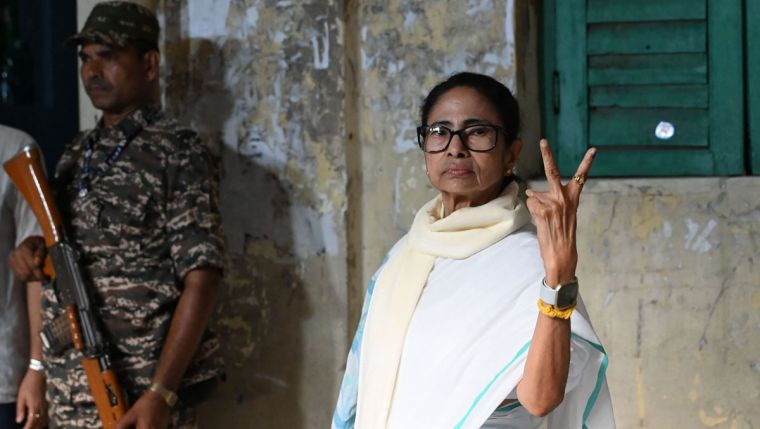
KOLKATA — As the second and most decisive phase of the West Bengal Assembly Elections 2026 unfolded on Wednesday, April 29, the political atmosphere in the state reached a boiling point. Chief Minister and Trinamool Congress (TMC) supremo Mamata Banerjee launched a scathing and unprecedented attack on the Election Commission of India (ECI) and the Central Reserve Police Force (CRPF), accusing them of “bulldozing democracy” and “openly harassing” voters and party workers to benefit the Bharatiya Janata Party (BJP).
The Chief Minister’s remarks came as she hit the streets of her Bhabanipur constituency as early as 8:00 AM, breaking her usual voting-day routine to personally inspect polling booths following reports of widespread intimidation.
“Never Seen Such a Democracy”
Speaking to reporters after casting her vote at the Mitra Institution school, a visibly agitated Banerjee described the conduct of the central forces and election observers as “atrocious.”
“I have seen many elections in my life, but I have never seen such a ‘democracy’ where the central forces and observers are used to unleash terror on common citizens,” Banerjee stated. “What is happening today is not at all a free and fair poll. The Election Commission has brought in observers from outside who are behaving like dictators. They are working as per the instructions of the BJP headquarters.”
The TMC leader alleged that CRPF personnel had been entering the homes of TMC workers late at night without the presence of local state police—a direct violation of established protocols. She specifically cited an incident involving TMC councillor ‘Babai,’ claiming that central forces harassed his wife and snatched her mobile phone while he was away.
The Battle for Bhabanipur
The high-stakes drama centered on Bhabanipur, where Banerjee is locked in a prestige battle against BJP’s Suvendu Adhikari—a rematch of their famous 2021 Nandigram encounter. The tension reached its peak when both leaders converged at a polling booth in Chakraberia around the same time.
While Banerjee sat outside the booth to register her protest against alleged “hooliganism,” Adhikari arrived under heavy security cover. The BJP leader dismissed the Chief Minister’s allegations as “frustration born out of fear.”
“Mamata Banerjee is scared because her local goons can no longer intimidate people now that the CAPF (Central Armed Police Forces) is here,” Adhikari told the press. “She is trying to create a narrative of victimhood because she knows Bhabanipur will reject her this time. The people should be allowed to vote without fear, and that is exactly what the central forces are ensuring.”
Allegations of Partisan Conduct
Banerjee’s primary grievance lies with the deployment of over 2,500 companies of central forces across the state for this phase. She argued that these forces, intended to guard the nation’s borders, were being “misused” for partisan political purposes.
“The central forces are supposed to be neutral, but here they are beating our workers and driving out polling agents,” she alleged, showing a video on her phone of a supporter who was purportedly assaulted by security personnel. “They are removing our party flags and posters while allowing the BJP to do whatever they want. Is this a ‘festival of democracy’ or a ‘festival of fear’?”
The Chief Minister also took aim at the appointment of specific police observers, including Ajay Pal Sharma, a high-profile IPS officer from Uttar Pradesh. The TMC has labeled such appointments as an attempt to “import encounter culture” into Bengal to suppress the ruling party’s base.
The Election Commission’s Stand
Despite the heavy fire from the ruling party, the Election Commission and the Chief Electoral Officer (CEO) of West Bengal, Manoj Agarwal, maintained that the polls were being conducted with the highest levels of transparency.
“We have made all arrangements for free, fair, and peaceful polls,” Agarwal said in a midday brief. “With 100% webcasting and 2,500 companies of CAPF, we are monitoring every booth. If there are specific complaints, they are being addressed immediately.”
The CEO also addressed allegations from the BJP that their symbols on Electronic Voting Machines (EVMs) were being covered with tape or ink in certain booths, stating that repolling would be ordered if any tampering was confirmed by district observers.
A State Divided
The second phase of polling covers 142 constituencies—nearly half of the state’s total assembly seats. While the voter turnout remained high—recorded at approximately 78.68% by 3:00 PM—the day was marred by reports of sporadic violence.
In Nadia district, a BJP polling agent was allegedly assaulted, while in Howrah, central forces reportedly resorted to a lathi-charge to disperse an agitated crowd following an EVM malfunction. In North 24 Parganas, the mother of the RG Kar victim, contesting on a BJP ticket, faced intense protests from TMC workers, further highlighting the deep-seated animosity between the two factions.
The Road to May 4
As the sun sets on this contentious phase of voting, the rhetoric from the Trinamool camp suggests a deepening rift between the state government and central institutions. TMC leaders, including Derek O’Brien, have already challenged Prime Minister Narendra Modi to resign if the TMC secures a victory on May 4.
For Mamata Banerjee, the allegations of “voter terrorism” serve a dual purpose: they act as a formal complaint to the judiciary and the public, while also galvanizing her “Ma, Mati, Manush” base against what she describes as “external interference” in Bengal’s internal affairs.
Whether these allegations will translate into a judicial challenge or if they are merely the final volleys of a heated campaign remains to be seen. However, one thing is certain: the 2026 Bengal elections will be remembered as one of the most polarized and digitally monitored chapters in India’s democratic history.







Leave a Reply