
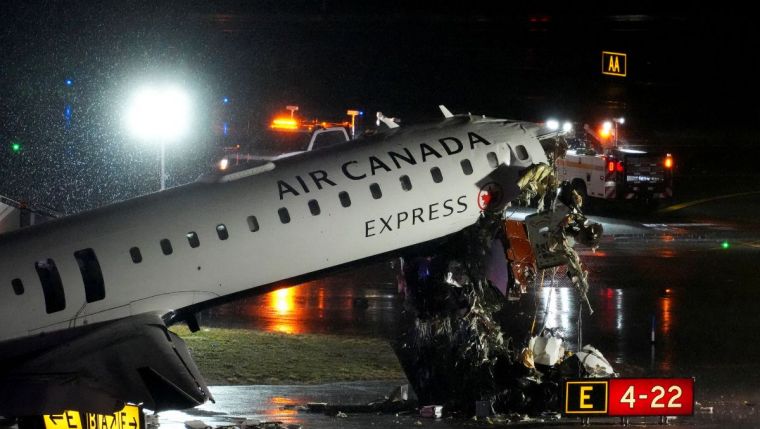
New York: In a tragic aviation accident, both pilots of an Air Canada Express flight were killed after their aircraft collided with a fire truck on the runway at LaGuardia Airport in New York late Sunday night. The devastating crash has left dozens injured, forced the temporary closure of one of the busiest airports in the United States, and triggered a high-level investigation into aviation safety procedures.
The incident involved Air Canada Express Flight 8646, a Bombardier CRJ-900 regional jet operated by Jazz Aviation, which had arrived from Montreal with 72 passengers and four crew members onboard.
Fatal Collision on Runway
According to officials, the accident occurred shortly after the aircraft landed on Runway 4 at LaGuardia Airport. As the plane was taxiing or completing its landing roll, it collided with a Port Authority fire truck that was on the runway responding to a separate emergency.
The impact was severe, destroying the front portion of the aircraft, including the cockpit area. Tragically, both the pilot and co-pilot died instantly due to the extent of the damage.
Visuals from the scene showed the aircraft’s nose crumpled and lifted upward, indicating the force of the collision despite the relatively low speed during landing.
Dozens Injured, Emergency Response Launched
Apart from the fatalities, the crash left over 40 people injured, including passengers, crew members, and emergency responders on the ground.
Several injured individuals were rushed to nearby hospitals, with reports suggesting that some sustained serious injuries. Firefighters and Port Authority personnel involved in the incident were also among those hospitalized.
Emergency teams responded within minutes, evacuating passengers through emergency exits and securing the area. Authorities confirmed that all passengers were accounted for following the evacuation.
What Led to the Crash?
Preliminary findings suggest that the fire truck had been cleared to enter or cross the runway as it responded to another aircraft-related emergency. However, the Air Canada flight was simultaneously approaching or landing, leading to a catastrophic miscalculation or communication breakdown.
Air traffic control audio recordings reportedly captured urgent warnings moments before the crash, with controllers attempting to stop the vehicle. However, the warning came too late to prevent the collision.
Experts say the incident raises serious concerns about runway coordination and communication protocols, especially at high-traffic airports like LaGuardia.
Airport Shutdown and Travel Chaos
Following the crash, the Federal Aviation Administration (FAA) immediately issued a ground stop, suspending all arrivals and departures at LaGuardia Airport.
The airport remained closed for several hours to allow emergency operations and investigation teams to secure the site. The shutdown led to widespread disruption, including:
- Hundreds of flight cancellations
- Diversions to nearby airports such as JFK and Newark
- Long delays for passengers across the region
Authorities warned that disruptions could continue even after operations resume, as airlines work to clear the backlog.
Investigation Underway
The National Transportation Safety Board (NTSB) has launched a full-scale investigation into the incident. A specialized “Go Team” has been dispatched to examine the crash site, review flight data, and analyze air traffic control communications.
Investigators will focus on several key questions:
- Why was the fire truck on the runway during landing?
- Was there a lapse in communication between air traffic control and ground crews?
- Did weather conditions play a role?
- Were safety protocols properly followed?
Early reports indicate that weather conditions, including rain and reduced visibility, may have contributed to the complexity of operations at the time of the crash.
Aircraft and Flight Details
The aircraft involved was a Bombardier CRJ-900, a commonly used regional jet for short-haul routes. The flight had departed from Montréal–Trudeau International Airport and was nearing the end of its journey when the accident occurred.
The plane was carrying a total of 76 people, including passengers and crew. While the cockpit suffered catastrophic damage, the main cabin remained largely intact, which likely prevented a higher death toll.
Renewed Focus on Aviation Safety
The LaGuardia crash has once again brought attention to aviation safety, particularly concerning runway incursions—incidents where unauthorized vehicles or aircraft are present on active runways.
Experts note that while such incidents are rare, they can be extremely dangerous due to the limited reaction time available during landing or takeoff.
This accident is expected to prompt a comprehensive review of safety systems, including:
- Runway access control
- Communication protocols between pilots and ground vehicles
- Use of advanced monitoring and alert systems
Conclusion
The tragic death of two pilots in the Air Canada Express crash at LaGuardia Airport marks one of the most serious aviation incidents of 2026 so far. While quick emergency response prevented further loss of life, the accident has exposed critical vulnerabilities in airport operations.
As investigators work to determine the exact cause, the incident serves as a stark reminder of the importance of precision, coordination, and safety in aviation. The findings of the probe will be crucial in ensuring that such a tragedy does not occur again.












Leave a Reply